Personal Workspace
/
Simulated Agents
/
Database Code #3
Improve conversion from free users to Super Duolingo
Date: 11/19/25
Time spent querying: 1hr 2m
Accuracy: 73%
N= 12,483
COHORT
IPG Conversation Agent
COHORT
SENTIMENT SCORE
0.82
TOTAL FEEDBACK VOLUME
29.3K



FILTER
SHOWING 4 PATTERNS OUT OF N = 12,483 USERS AND 12 SOURCES
Users describe lessons as repetitive after Day 3.
Repetition Fatigue
Agents: 6,128
Prevalence: High
Confidence: 0.82
Users are overwhelmed by the first time user experience.
Onboarding Cognitive Overload
Agents: 5,303
Prevalence: High
Confidence: 0.81
Users say that gamification isn’t consistently motivating.
Motivation Dependence on Gamification
Agents: 2,561
Prevalence: Medium
Confidence: 0.74
Users don’t believe that the value is worth the price.
Low Perceived Value
Agents: 974
Prevalence: Low
Confidence: 0.72
Filter By:
Common Patterns
Question Number
Users are overwhelmed by the first time user experience.
Onboarding Cognitive Overload
Agents: 5,303
Prevalence: High
Confidence: 0.81
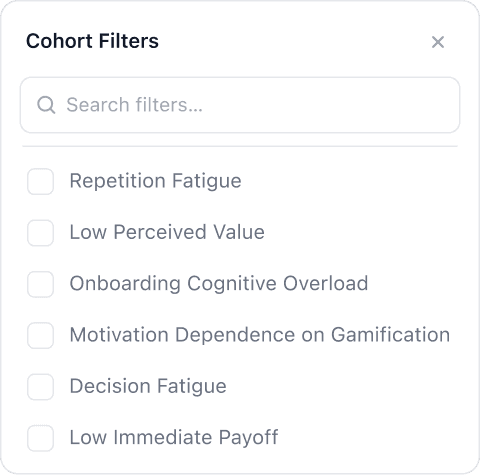
INFINITE PREDICTIONS GROUP (IPG)
ROLE
Founding Product Designer
SKILLS
Product Strategy
Systems Thinking
Cross-Functional Leadership
TIMELINE
3 weeks
OVERVIEW
Building AI simulations of company target users, so product managers can capture insights at 1/100th of the original time.
With a model based on real human data, IPG allows PMS to continuously engage with simulated human agents and make faster, more informed decisions.
THE SOLUTION
Using real human data, generate thousands of people at once, and interact with them to gain insights.
#1 FIND PATTERNS.
#2 TALK TO USERS— ASAP.
#3 UNCOVER DEEPER INSIGHTS.
#1 FIND PATTERNS.
CURRENT SPACE
Small product teams have never had more data, and yet they know less than ever about their users.

Even the best PMs rely on fragmented, biased, or stale signals to make decisions. Traditional user research is slow, expensive, and limited to a tiny fraction of the actual user base.
SO WHAT?
Access to users — and the ability to learn from them quickly — is structurally scarce and operationally heavy.
Every product team today faces the same systemic limitation: they can only talk to a fraction of their users, a fraction of the time.
Only 1/5 of users
20%

40%
60%
80%
100%
THE PROBLEM
User research is expensive and time-consuming for small teams, leaving many PMs to rely on proxy or intuition.
THE GOAL
Enable PMs to access user-grounded insights continuously without requiring dedicated research teams or long timelines.
THE GUIDING QUESTION
How can we seamlessly eliminate research bottlenecks so PMs can move faster with confidence?
AUG
APR
MAY
JUN
JUL
LOW CONFIDENCE
TIMELINE BOTTLENECK
USER RESEARCH
DISCOVERY PHASE
VALIDATION PHASE
DEFINITION
INTERNAL
RESEARCH
INSIGHT
PMs don't simply want mass data— they need the insights that matter. But how do they get there?
How do we design a workflow that returns insights quicker than traditional cognitive processes?
LIGHTBULB MOMENT
Real PM workflows are nonlinear. LLMs allow PMs to generate data and explore them however they want, furthering autonomy.
Mystery
Heuristic
System
Insight
Knowledge Funnel
EARLY EXPLORATION
PRODUCT THINKING
How should PMs explore thousands of responses?
Exploring the best possible interaction model for a PM's workflow.
ITERATION #1
Traditional filtering was too heavy-weight.
Personal Workspace
/
Simulated Agents
/
Educational Users
ipg
P...
Improve conversion from free users to Super Duolingo
Date: 11/19/25
Time spent querying: 1hr 2m
Accuracy: 73%
N= 12,483

FILTERS
Filter out your view of the databases.
SEGMENT
All Segments
>
APPLY FILTERS
>
CONFIDENCE
USER ID
LENGTH
SENTIMENT
QUALITY
USER #1
10m15s
Negative
High
USER #2
7m43s
Average
Average
USER #3
2m15s
Average
Low
USER #4
2m57s
Negative
Medium
USER #5
8m32s
Good
Medium
USER #6
2m15s
Average
Low
USER #7
3m24s
Negative
High
USER #8
2m17s
Good
Low
USER #9
5m29s
Negative
Average
USER #10
7m45m
Average
Medium
USER #10
2m15s
Average
Low
USER #10
7m45m
Average
Medium
I hypothesized that PMs would want direct access to individual responses so they could maintain trust in the raw data. However, it requires the PM to already know what they're looking for.
ITERATION #2
A chatbot as a filter results in bias.
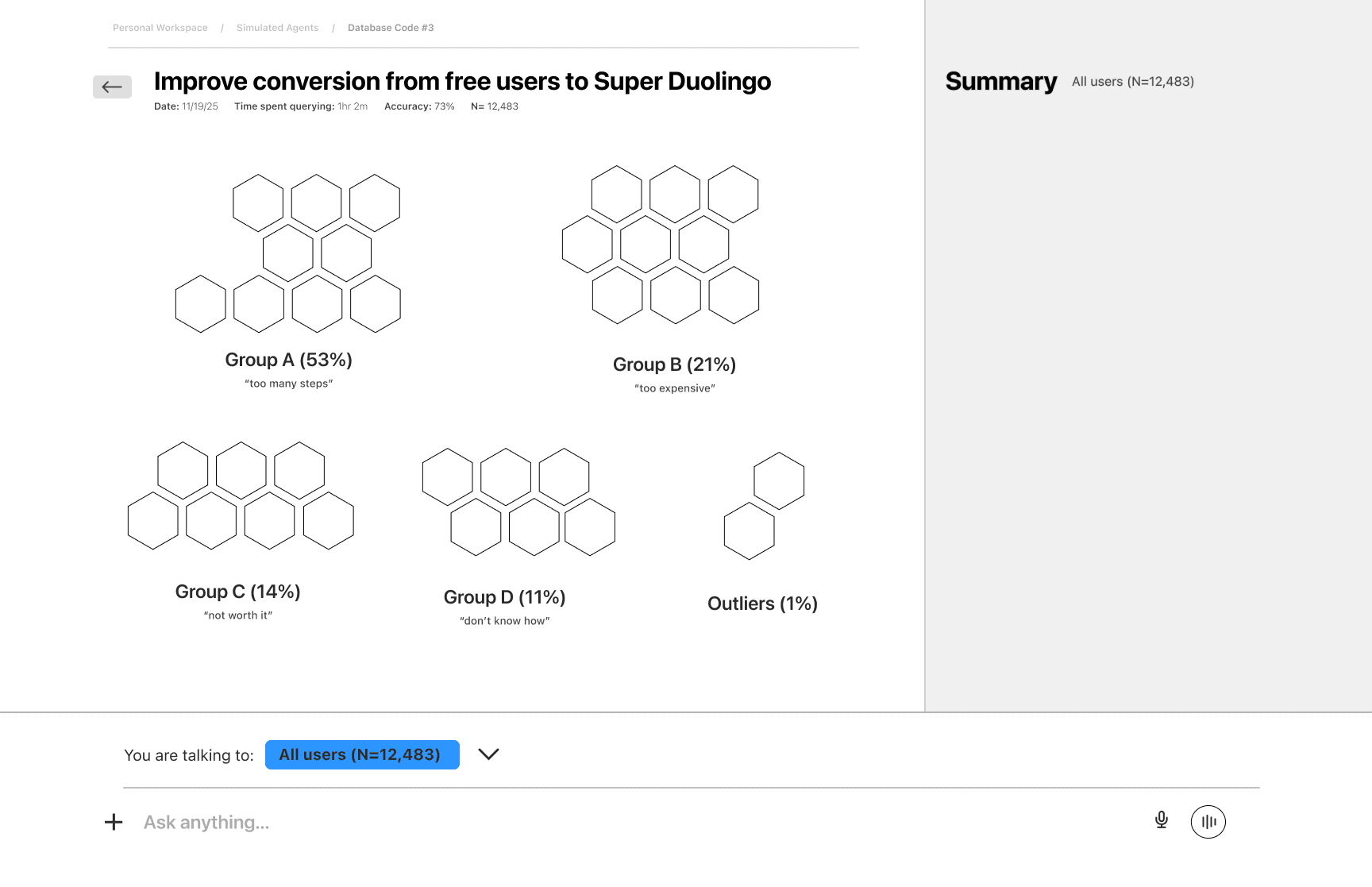
PMs had to know what to ask the chatbot, which resulted in a prompting bias. If they looked specifically for "Pattern A", they would've never known "Pattern B" was a problem!
ITERATION #3
A single chat interface felt like a black box and lacked ethos.
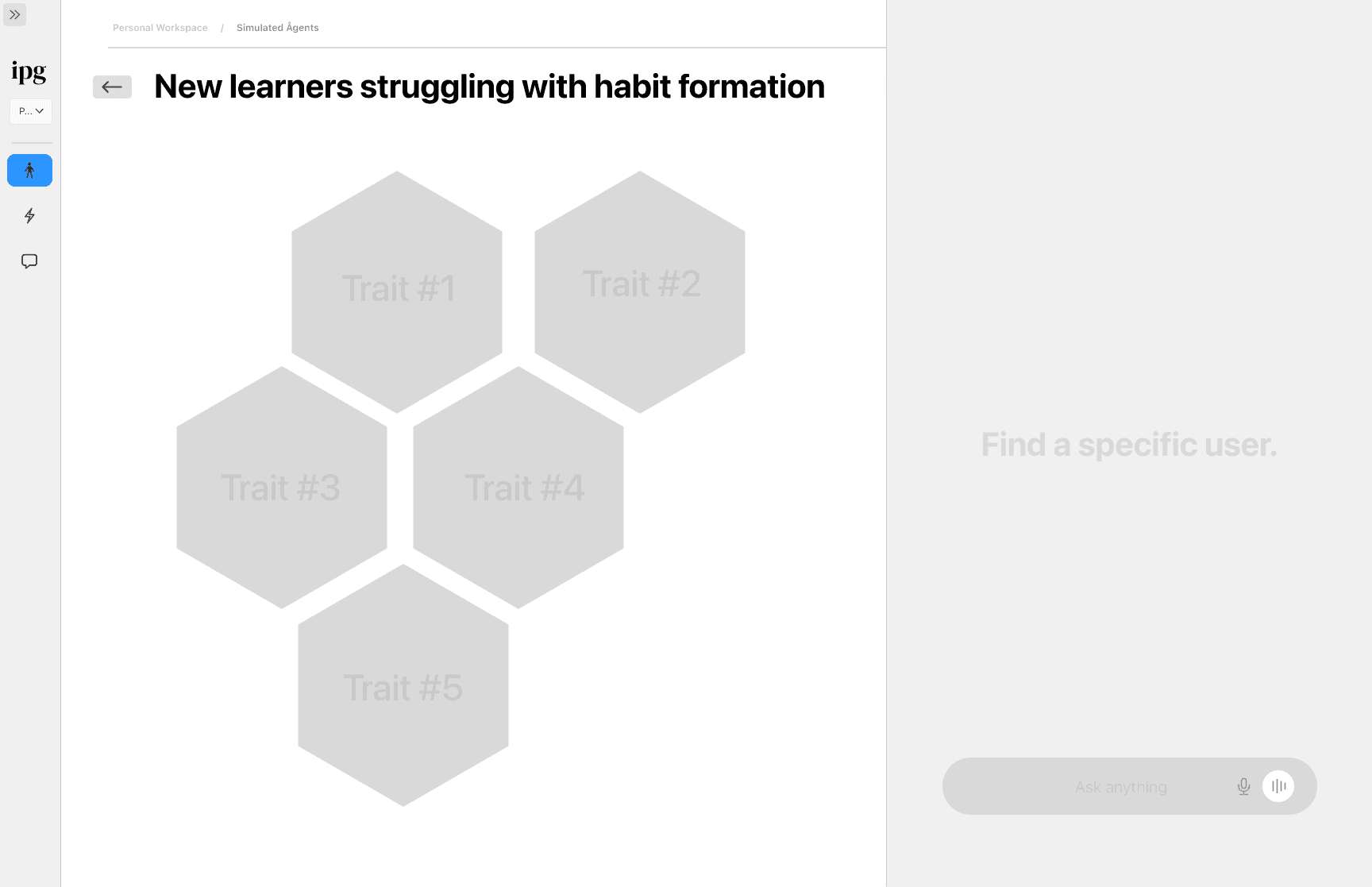
A lone “ask anything” box gave no sense of structure or grounding. It offered answers, but not the transparency or credibility PMs needed.
ITERATION #4
Emerging patterns from the system
Personal Workspace
/
Simulated Agents
/
Database Code #3
Improve conversion from free users to Super Duolingo
VIEW REPORT →
Date: 11/19/25
Time spent querying: 1hr 2m
Accuracy: 73%
N= 12,483
COHORT
IPG Conversation Agent
COHORT
SENTIMENT SCORE
0.82
TOTAL FEEDBACK VOLUME
29.3K


FILTER
SHOWING 4 PATTERNS OUT OF N = 12,483 USERS AND 12 SOURCES
Onboarding Cognitive Overload
Onboarding Cognitive Overload
Onboarding Cognitive Overload
Onboarding Cognitive Overload
I hypothesized that by grouping responses into patterns first, it would reduce complexity and help PMs start from higher-level insights instead of raw volume.
However… there were some tradeoffs with emerging patterns:
Trust
Why should a PM trust a pattern they didn't find themselves?
Comprehension
How does a PM go from seeing a pattern to understanding why it exists?
KEY QUESTION:
How might we help product managers trust patterns enough to act on them, without constraining their autonomy?
SOLUTION:
A two layer system!
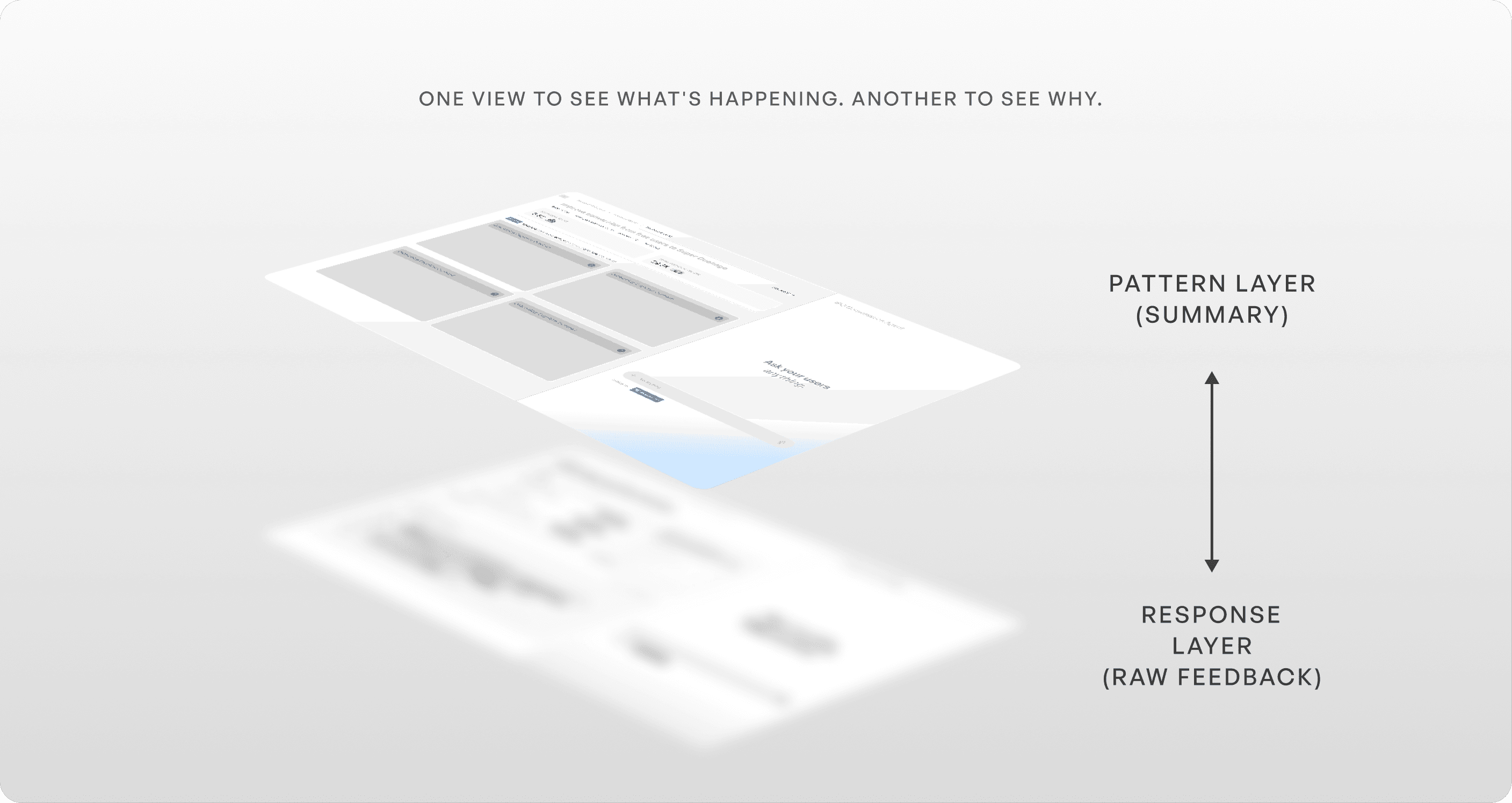
The overview stays intact while the PM investigates. They can go deep on one pattern and come back without losing their place.
SYSTEMS THINKING
Connecting the two surfaces
PMs move between the overview and detail constantly. What helps them decide which pattern to open?
SOLUTION:
The pattern card
Jumping from the index to the full detail view is too much, too fast— but the card bridges that gap.
Repetition Fatigue
Users consistently describe lessons as becoming repetitive after Day 3 of the program. Multiple segments report declining engagement tied to perceived redundancy in content structure and pacing.
Matched Users:
6,128
Prevalence:
High
Confidence:
0.82
Repetition Fatigue
6,218
MATCHED USERS
PREVALENCE
High
CONFIDENCE
0.82
Users are overwhelmed by the first time user experience.
Onboarding Cognitive Overload
Agents: 5,303
Prevalence: High
Confidence: 0.81
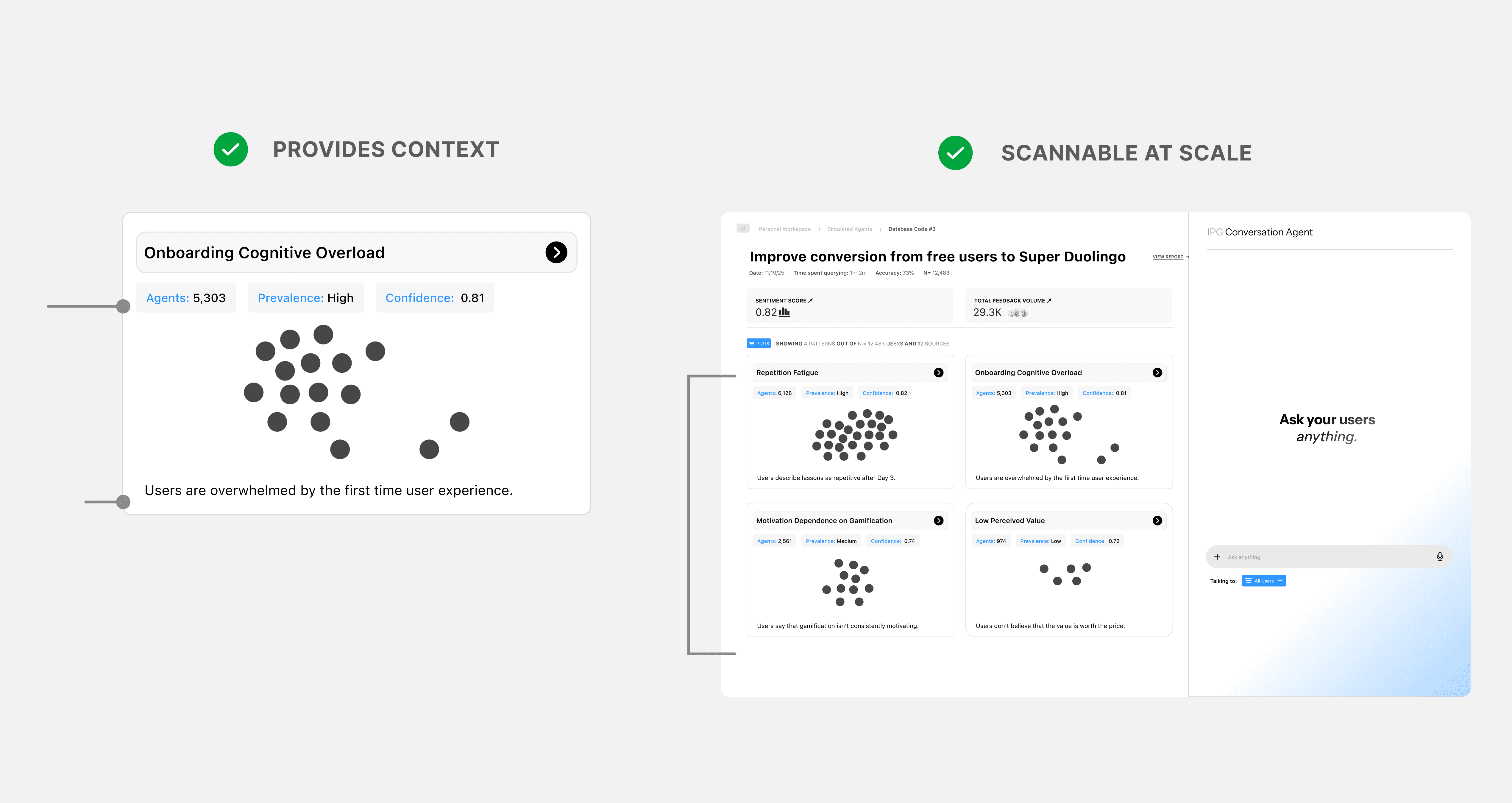
I explored what info a PM needs at a glance to decide if a pattern is worth opening.
CARD EXPLORATION #1
Prioritizing context for a pattern
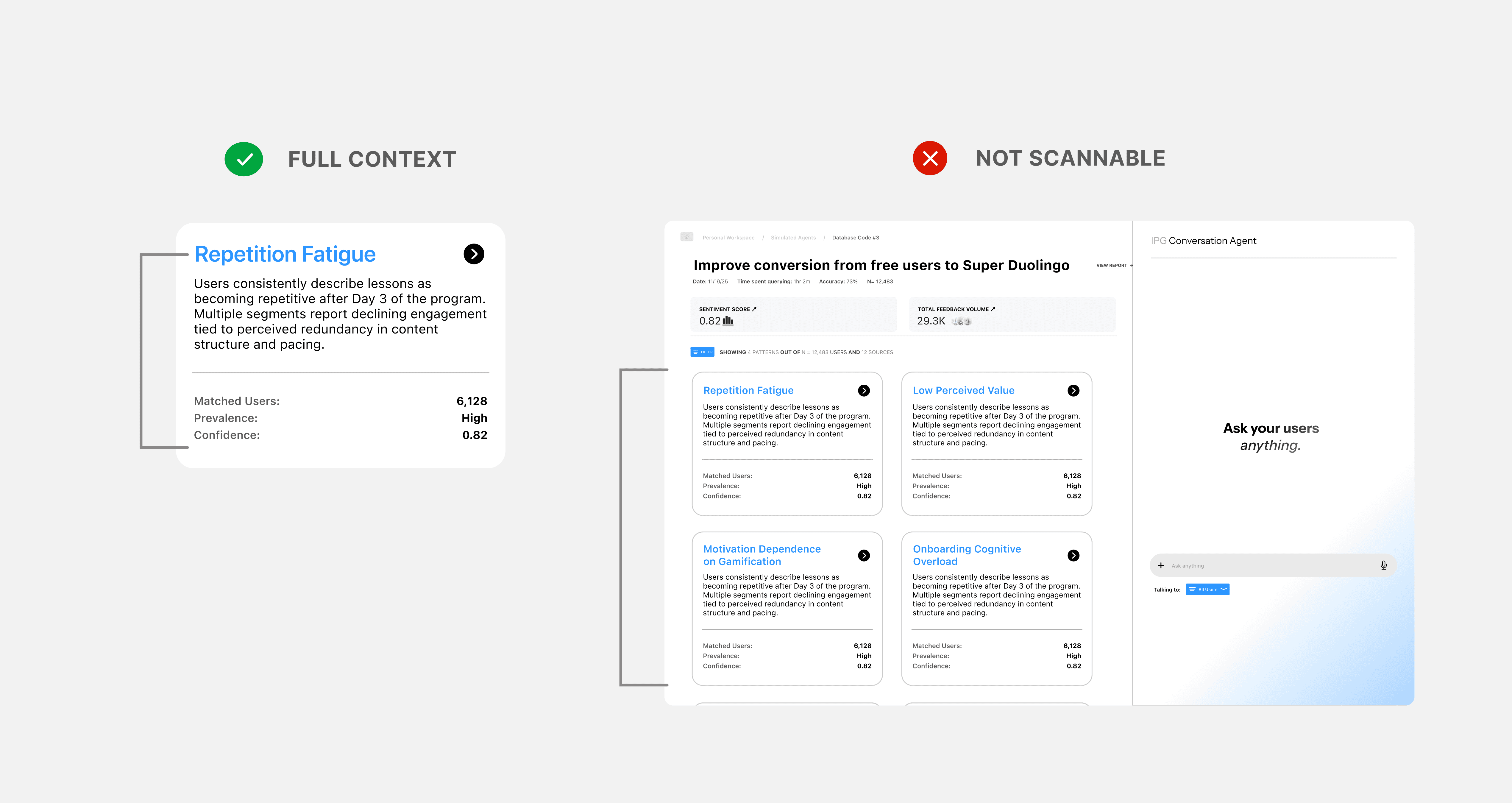
CARD EXPLORATION #2
Prioritizing comparison
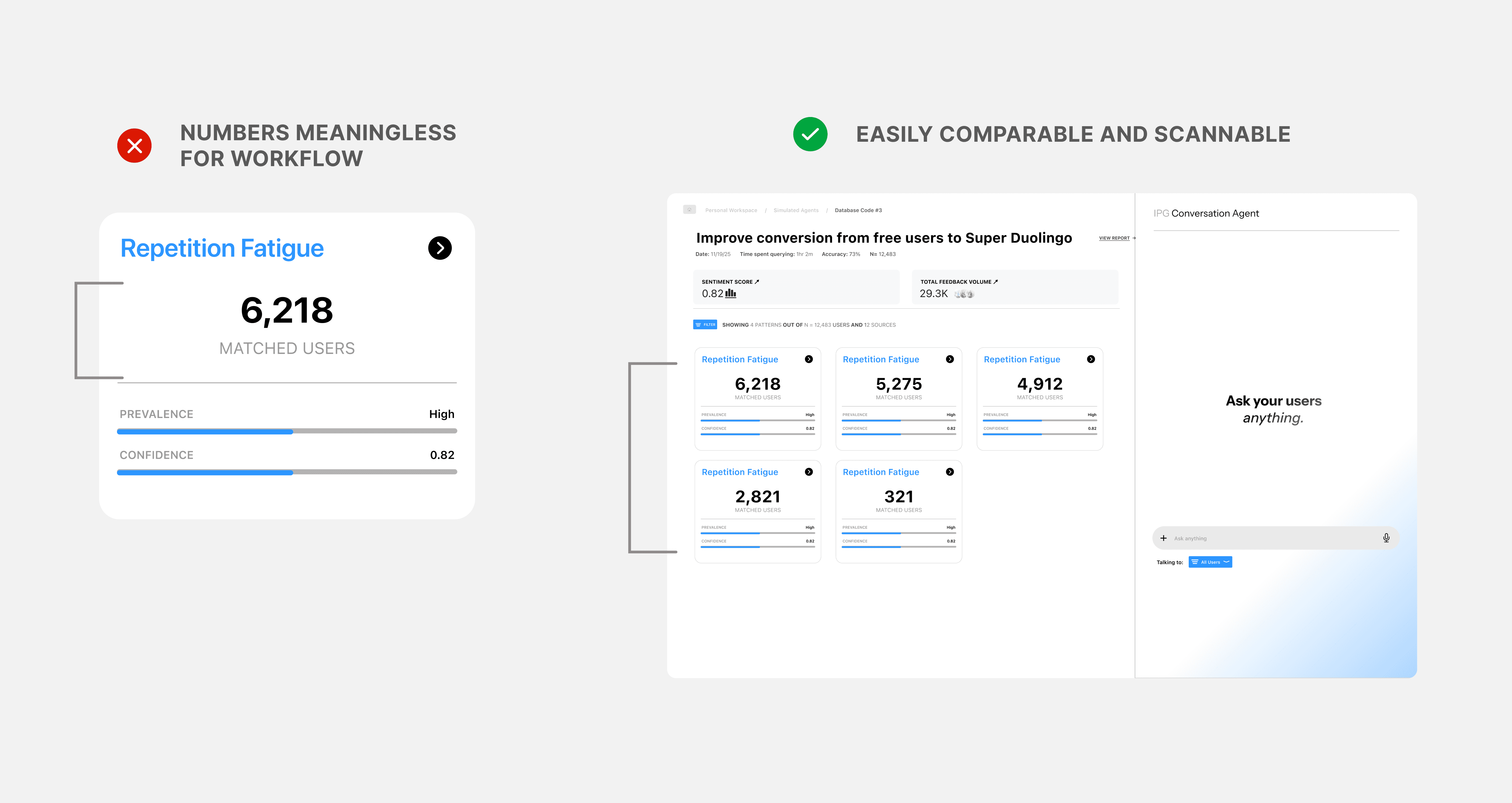
FINAL DESIGN
Balancing both context and scannability
HOME STRETCH!
Final Solutions
After establishing the interaction system and components, I translated them into full flows:
FLOW #1
INTERVIEW CAMPAIGN CREATION
CONTEXT-AWARE QUESTION GENERATION
Kickstart research in seconds.
PMs describe their goal, and the system automatically generates targeted, context-aware interview questions grounded in user behavior, evidence, and most importantly: your goals.
REVISE, REFINE, FOLLOW-UP
Edit, refine, and deepen your questions with a single prompt.
They can refine, adjust tone, or add follow-ups — ensuring every question maps back to the insight they’re trying to uncover. Recommendations from artificial intelligence are not primary, but rather, a secondary suggestion— for a further sense autonomy for PMs.
ITERATE SMARTER AND FASTER.
Generate a complete interview guide in an instant.
PMs have a research starting guide in only seconds, without the blank page.
FLOW #2
TALK TO YOUR USERS
DYNAMIC CHAT INTERFACE FLOW
Receive instant answers from the simulated agents.
After the interview, users can talk to the interviewed data-base, or talk to specific cohorts of similar patterned individuals.
HYBRID FILTERING SYSTEM
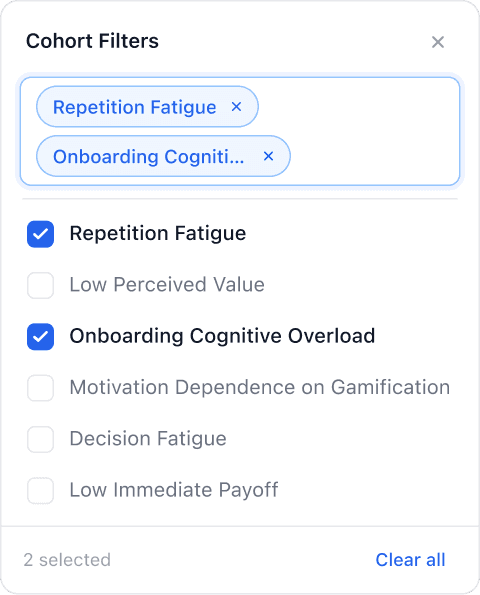
Segment the users and patterns which you want to interact with.
Users can talk to the interviewed data-base, or talk to specific cohorts of similar patterned individuals,
GRANULARITY WITHIN DATA
Zoom into any segment in one click— the dashboard shifts dynamically according to PM needs.
Instead of overwhelming PMs with hundreds of filters, the system reveals insight layers progressively. Each step gets more specific only when PMs ask for it.
USER-LEVEL DEEP DIVES
Truly— any user.
PMs can click any individual user in a cohort to inspect their personal habits. It takes what would normally require hours of 1:1 interviews and condenses it into a deeply contextual profile.
Reflections
Balancing AI and design.
Building with agentic systems has been quite intriguing. It's important in knowing when to stay out of the way. Too much adaptation and people feel like they’ve lost control. Too little defeats the point.
Always design in systems!
Nothing was designed in isolation — every component depended on one another. It's important to design for scalability and further expansion of the interaction system versus siloing into one feature.
Prioritize ruthlessly.
Before diving into the project, it was important to be cognizant of our business goals (and constraints!) at the moment to understand what needed attention, and what didn't.